

01
Different raw materials
The main raw material for pottery such as tea cups/bowls is clay, while the ceramics used for cutting tools are based on high-hardness, chemically stable raw materials such as alumina Al2O3 and zirconium dioxide ZrO2. They are made of materials much harder than clay.
02
Different molding methods
Teacups/bowls and other pottery are mostly made by hand or hand-made utensils. The cutting ceramic tool is to load the raw materials into a special mold, and then use special equipment to press and form about 1 to 2 tons per square centimeter, thereby eliminating the gap between the particles and forming a high-strength ceramic tool material.
03
Different sintering temperature
Pottery such as teacups/bowls is sintered at relatively low temperatures of about 900 to 1300 ° C, while ceramic cutters used in cutting are sintered at high temperatures above 1500 ° C. In addition, the sintering temperature and sintering time are strictly controlled to ensure the production of high-quality, high-performance ceramic tools.
The same is ceramic, due to the above raw materials, production processes and other different, so that ceramic tools have two excellent characteristics.
Let's take a look at how ceramic tools can use these characteristics to play a role in high-speed machining.
Even in a high temperature environment, it can maintain a high hardness.
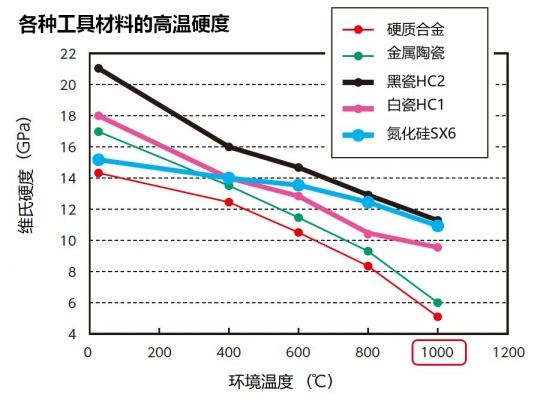
The figure above shows the relationship between ambient temperature and material hardness.
Most materials soften when heated, as do cutting tools. The higher the ambient temperature, the greater the decrease of material hardness. The hardness of cemented carbide and cermet at 1000 ° C will drop to about 35% of the normal temperature state.
And ceramics (white porcelain HC1, black porcelain HC2, silicon nitride ceramic SX6) under the same conditions, the hardness decline is much smaller. In particular, the silicon nitride ceramic SX6 material, even at the temperature of 1000 ° C, its hardness can still be maintained at about 73% of the normal temperature state.
Even in a high temperature environment, it can maintain a high bending strength.
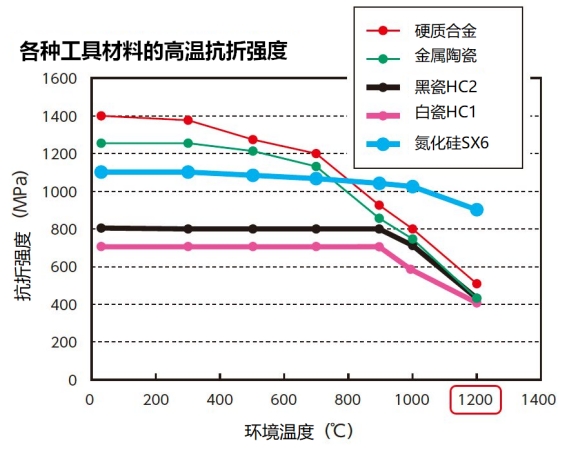
The figure above shows the relationship between ambient temperature and the bending strength of the material.
Cemented carbide has high bending strength and is not easy to crack at room temperature. Even so, as the ambient temperature rises, the strength decreases sharply. When the temperature reaches 1200°, the strength decreases to about 35% compared with normal temperature.
And ceramics (white porcelain HC1, black porcelain HC2, silicon nitride ceramic SX6) under the same conditions, the strength decline is much smaller. In particular, the silicon nitride SX6 material, even at the temperature of 1200°, its strength can still be maintained at room temperature of about 82%.
We know that during the cutting process, the friction between the tool and the material to be machined will produce a lot of cutting heat. The faster the cutting speed, the higher the temperature of the tool tip rises, the harder the tool hardness and bending strength are to maintain, which limits the cutting speed that can be used in normal processing. The ceramic tool uses its material characteristics of high hardness and good folding strength in the field of high temperature to achieve high-speed processing far beyond cemented carbide, thereby greatly improving production efficiency.
(Material from the Internet)