

Oxidation behavior of porous and powdered silicon nitride
Dynamic oxidation atmosphere, porous and powdery sample will make silicon nitride oxidized more seriously.
There are two forms of silicon nitride powder oxygen, one is to form a silica oxide layer on the surface, and the other is to enter the silicon nitride lattice to form oxygen defects. In the powder preparation process, the oxygen adsorbed inside the crystal lattice and on the surface of the powder particles is about 1wt%. At high temperatures, oxygen dissolves in the lattice and replaces nitrogen atoms to form silicon vacancies, forming scattering centers during phonon propagation and affecting the thermal conductivity of silicon nitride. The lower the oxygen content of the powder, the better the comprehensive properties of the prepared ceramics.
Wang Yuelong et al. selected silicon nitride powder with an initial oxygen content of 1.21wt% and oxidized it at different temperatures at 573K-1273K in flowing air.
Variation of oxygen content of silicon nitride powder with temperature
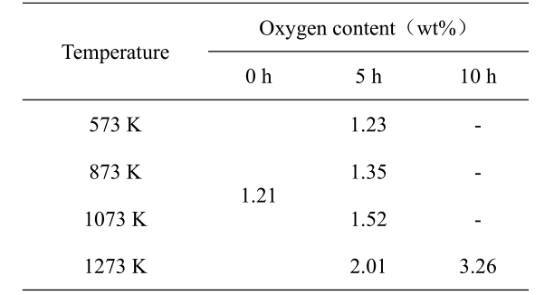
The results show that the silicon nitride powder has good oxidation resistance, the oxygen content of the powder below 1073K is almost no increase, the oxygen content of the powder increases slowly between 1073K and 1273K, and the oxygen content increases sharply to 1273K. After holding at 1273K for 5h and 10h, the oxygen content of silicon nitride powder increased to 2.01wt% and 3.26wt%, respectively, and the surface oxide layer thickness increased from 0.45nm to 1.05nm and 2.31nm. Through theoretical calculation and XPS detection, the lattice oxygen content of silicon nitride powder is about 0.5wt%.
He Fengmei found through the study of porous Si3N4 that under the atmospheric pressure static air atmosphere, the oxidation reaction of porous Si3N4 is very weak; above 800℃, the obvious oxidation reaction can be seen; above 1000℃, the oxidation reaction is intensified, and the weight gain rate is accelerated, and it preferently occurs at the surface and external pore wall, and then in the internal pores of the sample. The oxidation reaction is controlled by chemical kinetics at the interface. In addition, at the same temperature, the dynamic oxidation atmosphere will accelerate the oxidation of Si3N4, especially for porous and powdered samples.
Oxidation mechanism
Similar to silicon carbide materials, the oxidation mechanism of silicon nitride is divided into active oxidation and passive oxidation mechanism with the difference of oxygen partial pressure and temperature. Active oxidation refers to the reaction of silicon nitride and oxygen to produce silicon monoxide and nitrogen. The passive oxidation mechanism is the basis of transition temperature analysis, so it is necessary to have a clear understanding of the passive oxidation mechanism of silicon nitride. The reaction formula is as follows:
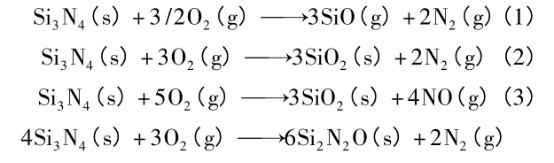
The reaction of silicon nitride under the active oxidation mechanism is mainly formula (1), and the reaction under the passive oxidation mechanism is mainly formula (2). Some researchers found in the experiment that there may be reaction (3) in the passive oxidation mechanism at the same time. In addition, the reaction equation (4) may occur at the interface of SiO2 and Si3N4.
Reaction mechanism under passive oxidation mechanism
By thermodynamic calculation, Chen Siyuan et al. studied the proportion of reaction formula (3) in the passive oxidation mechanism at a given temperature and pressure, and found through experiments that the ratio of NO to N2 was very small, so it can be considered that the reaction of passive oxidation mechanism of silicon nitride is only reaction formula (2). The increase of temperature and oxygen partial pressure at the interface will increase the pressure of NO, that is, the possibility of reaction (3) will increase.
In the environment of high temperature and low oxygen partial pressure, silicon nitride transforms from passive oxidation mechanism to active oxidation mechanism, forming SiO and N2, oxidizing film is destroyed, anti-oxidation mechanism fails, and material begins to ablate. The oxidation resistance of silicon nitride is ineffective after ablation, and the wave transmittance of the material is seriously affected. Therefore, the region where the oxidation mechanism of silicon nitride changes is very important to study its oxidation resistance and wave transmittance.
At the same temperature, when the concentration of oxygen decreases, the oxidation mechanism of silicon nitride changes to active oxidation. When the oxygen partial pressure is constant and the surface temperature rises, the oxidation mechanism changes from passive oxidation to active oxidation.
The transition temperature curve of silicon nitride under different oxygen partial pressure was obtained by Chen et al. The curve divided the oxidation region into passive oxidation region and active oxidation region.
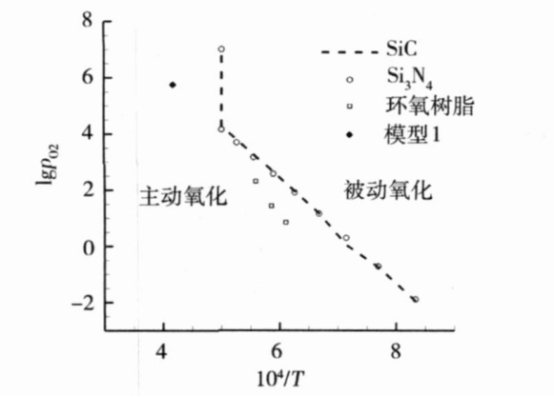
Transition temperature of silicon nitride at different oxygen partial pressures
peroration
Silicon nitride ceramics have high theoretical thermal conductivity, and the second phase content and lattice defects, especially the oxygen defects in the lattice, have a great impact on the thermal conductivity of silicon nitride ceramics. Therefore, it is very important to study the oxidation resistance of the powder, the form of oxygen in silicon nitride and its oxidation mechanism.
(Material from the Internet, intrusion)