

High-precision optical systems and analytical laboratory instruments demand exceptional structural consistency to deliver accurate readings and stable optical performance. Even minor dimensional shifting, thermal expansion or micro-deformation can cause optical misalignment, measurement deviation and inconsistent experimental data. Traditional metal, plastic and standard ceramic components often fail to sustain long-term precision under fluctuating temperatures, vacuum environments and continuous mechanical stress. For advanced scientific and optical equipment, selecting high-stability structural materials has become the core factor to improve instrument accuracy and service reliability.
Machinable Glass Ceramic has become a preferred structural material for high-end optical and laboratory equipment due to its ultra-low thermal expansion rate and excellent mechanical rigidity. Unlike brittle industrial ceramics, this composite glass-ceramic material maintains stable dimensions during repeated heating and cooling cycles. It resists warping and structural fatigue, effectively preserving the precise calibration of optical benches, lens mounting frames and laboratory testing platforms. Its outstanding environmental adaptability ensures consistent equipment performance in precision detection and scientific research scenarios.
Precision instrument assembly requires flat, smooth and high-tolerance support components that fit compact equipment layouts. Machinable Ceramic Plate is widely customized into precision base plates, insulating platforms and fixture supports for optical instruments and lab devices. With fine CNC machining and surface polishing, these flat ceramic parts achieve ultra-high flatness and tight dimensional tolerance. They provide stable horizontal support for optical calibration systems, effectively reducing structural vibration and position offset during equipment operation, which greatly improves the stability of optical signal transmission and experimental testing.
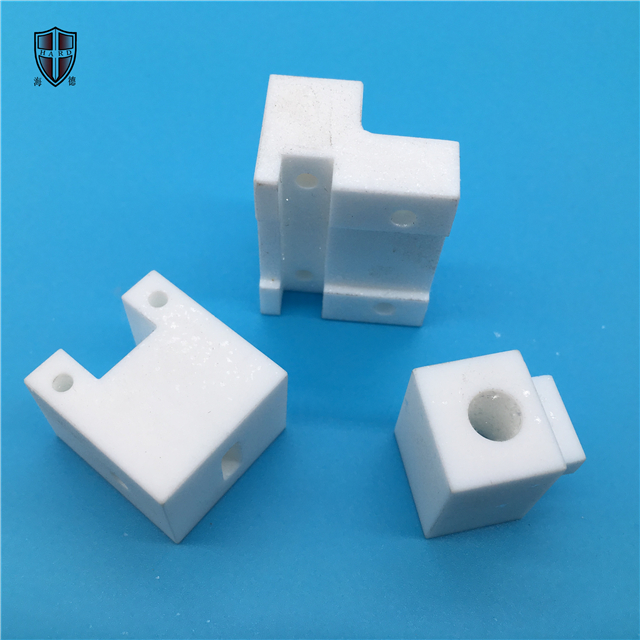
Modern laboratory and optical equipment often requires complex customized structures rather than simple standard parts. General refractory materials are difficult to machine and prone to chipping, making them unable to meet personalized structural design needs. Machinable Glass Ceramic Block features superior processability, allowing precise drilling, cutting and grooving without cracking or internal damage. Manufacturers can process solid blocks into various customized shapes, sizes and hole positions to match diverse instrument structures, solving the difficulty of producing high-precision special-shaped insulating and supporting parts.
In addition to excellent dimensional stability, the material also delivers reliable electrical insulation and chemical inertness. It resists corrosion from common laboratory reagents, humidity erosion and high-voltage breakdown, ensuring long-term stable operation in rigorous experimental and optical working environments. Compared with traditional materials, it greatly reduces equipment calibration frequency and replacement costs, bringing higher efficiency and stability to scientific laboratories and optical precision manufacturing industries.
As optical detection technology and laboratory analysis equipment continue to develop toward higher precision, the demand for dimensionally stable, machinable high-performance ceramic components will keep growing. Advanced glass ceramic materials will continue to support the upgrading of precision instruments and become an indispensable core material in high-end scientific research and optical industrial fields.