

Because alumina ceramics possess many diverse properties, they can be manufactured into a wide variety of products. For instance, due to their high mechanical strength, they can be used as mechanical structural components; their high resistivity and excellent electrical insulation make them ideal materials for substrates, sockets, and circuit housings.
Furthermore, the high hardness of alumina ceramics enables the manufacture of tools, grinding wheels, abrasives, wire drawing dies, extrusion dies, and bearings; its high melting point and excellent corrosion resistance also make it an essential material for furnace tubes, crucibles, fibers, and thermocouple protection tubes. In addition, alumina ceramics can be used to manufacture crucibles for pure metal and single crystal growth, human joints, artificial bones, sodium vapor lamps, microwave rectifiers, infrared windows, laser oscillators, solar cell materials, and battery materials.
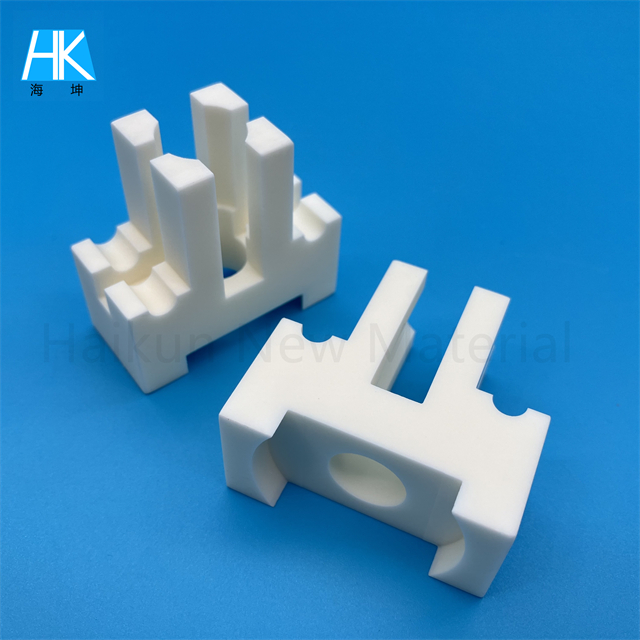
Alumina ceramics are also divided into different types. 99.7% alumina ceramics use high-purity alumina materials and undergo a series of strict processing steps to ensure superior performance. Compared to 99% and 95% alumina, it has higher density and flexural strength.
Compared to 95% alumina, 99% alumina ceramics have advantages in density and microstructure, resulting in a suitable performance-to-price ratio, making them suitable for parts with high performance requirements and moderate price. 95% alumina ceramics use pure alumina materials and diverse preparation processes, ensuring the inherent properties of alumina ceramics while continuously reducing manufacturing costs.
Therefore, compared to the other two high-purity materials, 95% alumina ceramics have slightly lower performance indicators and density, but still possess all the excellent properties of alumina ceramics, making them suitable for utilizing the advantages of alumina ceramics and applicable to ordinary parts.